Showing posts with label animals. Show all posts

21 February 2012

A last look for lemurs

Our itinerary change meant that we had a couple days to explore a little further for lemurs. So we headed east again, using Grace Lodge inthe village of Andaribe as a base. On the way, we stopped at a private reserve where we were able to see these brown and white lemurs at close range.


By this point I admit I was feeling travel-weary so I took a down day while Rob hiked with Dorique and a local guide in the nearby park.  We have some work to do on naming the lemur species accurately, but here are some wonderful shots, courtesy do Dorique (who quite enjoyed using my Lumix FZ150 with its 24x zoom).


Yes, that is Rob with a lemur on his head!  Rob and Dorique went to Lemur Island which is a sanctuary for orphaned lemurs that truly is an island. 


The lemurs are fed so they cannot be returned to the wild, but they are breeding successfully which does help protect their numbers.  It's better than no action at this point, but our travels in Madagascar revealed one painful truth: natural habitat for all wild animals is being eliminated at a catastrophic rate on this island.  The protected forests that remain are critical to the survival of these intriguing and unique primates, but they too are under threat.  Mining, farming, logging for charcoal production and fires (both natural and deliberate) all impact on the viability of the forests and the creatures who inhabit them.


We feel blessed that we were able to come and experience rural life, the animals and even the environmental complexities of Madagascar.  Below, Grace Lodge in the morning mist will stay with us as a parting image.


15 February 2012

Lemurs in the treetops

Rob has held a dream in his heart for 40 years - to see the lemurs and other rare animals of Madagascar.  When we reached the rainforest of Ranomafana, we hoped to fulfill that dream and the central objective of this journey.  Located in the south-central region, Ranomafana National Park was established in 1991 to protect the golden bamboo lemur, a species that was not known until 1985. The 41,000-hectare park has become one of the most important wildlife sites in Madagascar because of its diversity of species.  


The terrain of the park is dominated by the gorge of the Namorona River with forested hills reaching 600 to 1400 metres.  Our six-hour hike involved lots of climbing and steep descents through the thick montane forest.  The paths were good though, so that we could get within viewing distance of the animals.  We were very fortunate; we saw lemurs, lots of lemurs.


Our talented local guide, Elyse (put and accent on the final e in his name), led us in close to watch four different species of lemurs. It was incredible. For the details in this post I'll rely on the guidebook Elyse loaned me - Madagascar Wildlife, 2008, by Garbutt, Bradt, and Schuurman.


The golden bamboo lemur prefer the young leaves and new shoots of giant bamboo. The tree is rich in protein, but also contains high level of cyanide that would be lethal to other animals. These lemurs are generally seen in family groups of two to six, but three or four is normal.


We also saw the eastern grey lemur, but I was not able to learn much about them.  Something to research further when we get home. 


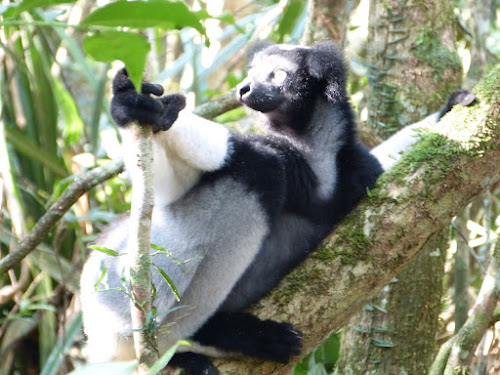
The Milne-Edwards' sifaka fulfilled my dreams for siting lemurs.  Their beautiful black and white fur made me think of panda.  This species has been studied quite extensively in Ranomafana and some of the animals we saw had radio collars.  Its known that this sifaka has a range of up to 55 hectares and will travel about a km per day feeding and resting. They live up to 30 years. Dorique took several wonderful photos of these lovely creatures for us.


The red-fronted brown lemur were exciting to see.  The males have a grayish coat with a rusty crown while females are pale chestnut brown with a grey crown.  The species is distributed between eastern and western forests of Madagascar, but the animals in Ranomafana tend to have a darker body color.  These lemurs make fruit the mainstay of their diet.


Much later, as it was growing dark, we took flashlights and went for a hike on the roadside near the park.  Elyse rubbed banana on several trees as a way of enticing the nocturnal mouse lemur to come out.  This shy little lemur feeds only on fruits.  


We waited and waited some more.  We whispered about the importance of patience when hoping to see special animals.  And at last the mouse lemur did appear to lick at the banana we'd offered. We had only a moment to view it in the light of a flashlight before it scurried back into the rainforest. It was worth the wait.


Here we are with Elyse during our lunch break in the park.  My attractive outfit (socks over pants and canvas hat) is not protection against biting flies like at home; instead, it's protection against leeches!


And here we are celebrating a wonderful day in the company of lemurs.


06 February 2012

A captivating corner of Botswana

It was Saturday and we were riding down the Zimbabwean highway in an open jeep, heading for the Zimbabwe-Botswana border. Our destination? The Chobe Game Lodge located inside the Chobe game reserve in Botswana. That's right, another stamp in our passports as we continue our search for wonderful African game. Chobe was to be our last safari experience and it was special, although because the rainy season had come to Botswana, the animals were more scarce and much harder to spot.


We had heard that Chobe was home to more elephants than any other reserve in Africa and we did see lots of elephants in our three game drives. I joked as we scanned the teak trees and grasses for my favorite animals, that my goal is to take 10,000 elephant photos.  I have posted lots of tusker pictures, so I will just offer this feisty young male side-stepping beside our jeep; he was a character.  

And this dear little one sheltering from the rain under his mother.

Chobe River proved a wonderful place to see hippos.  See the little one cuddling up to mama?  Hippos come out of the water to graze, most often at night, so it was a treat to see them while there was plenty of light for photos.


We were quite delighted by the spectacular bird life in the reserve.  I'm not sure if I can properly identify the species I was able to capture, but you will likely agree they are wonderful. (Leave a comment if you can help to more accurately identify these birds.)


Little Egret


Our guide kept calling this large-billed bird the "Chili pepper bird"


Snake bird


African Fish Eagle


As our last game drive came to a close, we had one more delightful surprise -- five lion cubs waiting in the long grass for their lionesses to bring home supper.  


Our last evening in the lodge was relaxing and fun.  We shared stories with other travelers and enjoyed the excellent food -- perhaps the best fare we've had anywhere in Africa.  Then it was another wake-up call, the reverse truck ride and border-crossing into Zimbabwe, a flight to Johannesburg.  I am writing this post on our last night in Africa. Tomorrow we fly to Madagascar; so stay tuned for further adventures.


20 January 2012

An African playlist


On safari, we found ourselves singing "Diamonds on the Soles of her Feet" (I know, Paul Simon again) as we took in the morning view under the bimini top of our Land rover.  Wondering what else is playing on my iPad?  Here's some of my playlist for Africa. 

Fatima - K'naan
Walk on the Wild Side - Lou Reed
Lovers in a Dangerous Time - Barenaked Ladies
Wondering Where the Lions Are - Bruce Cockburn
Wild Life - Paul McCartney and Wings
Otana, My African Dream - Claude Carmichael and George Marinelli (the BEST version)
Kalimba - Mr. Scruff

And, a whole bunch of wonderful tunes with Amin Bhatia and Johnny Clegg in collaboration, including:

Garden of Eden
Trouble in Paradise
Family Tree
My Beautiful Baboon

I think tunes by Johnny Clegg sound like Africa. And the whole of Paul Simon's "Graceland" feels like Africa calling.  I love this music and I keep making Rob listen to this playlist in our hotel room. I heard him humming "Homeless" today.


This post is for friends in Edmonton ... For Holly Huber who loves to make playlists. And for Peter Hamilton who enjoys an amazing mash-up of tunes on his iPod every day. We have really tried to get into the spirit of things on the African leg of our journey.

21 November 2011

The great migration


We are busy reading all things safari and learning that January in the Serengeti should be an interesting time for animal viewing.

"The extraordinary annual Great Migration of wildebeest and other grazing herbivores across the Serengeti-Mara ecosystem is one of the greatest spectacles in the natural world. Over two million herbivores partake in this journey, with about 200,000 zebra and 500,000 Thomson's gazelle behind the main players... one-and-a-half million wildebeest!"

Read more at and check out the interactive migration map.  And for even more facts, read this fact file.

 Also view the migration in this National Geographic video.