Showing posts with label geographic landmarks. Show all posts

26 March 2012

Heights and sights of Hong Kong

The view from the Intercontinental Hotel in Kowloon, Hong Kong doesn't disappoint, even in a smog-laden dusk. We stopped in for drinks, but realized we were in time for afternoon tea which was served in high style -- a diminutive three-tier sandwich tray arrived with individual china teapots, cups and strainers for pouring clear tea. Fine, indeed. We sat and watched the junks, ferries and barges plying the harbor waters, still amazed to find ourselves in this fabled, high-speed city.


Built on a 427-square-mile piece of real estate, Hong Kong is home to seven million people. It's a city with a vertical presence; high-rise buildings reach skyward at every turn.


Hong Kong is an interesting city to explore, albeit at a hectic pace. All those residents have places to go too, as we discovered when we found ourselves on the Metro at rush hour. Come with us as we jump aboard at Tin Hau, the station near our hotel. Built deep unserground, the Metro runs just about everywhere in the city. It's the best way to travel.


Long before the Metro, when Hong Kong was an important piece of the British empire, people relied on the the Peak Tramway to reach the the Mid-Level neighbourhoods and the popular lookout on Victoria Peak. Today, taking the funicular to the Peak is a sight-seeing must. So we did, although on a Saturday it took ages to work through the line and catch a ride. The things we do to grab hold of a piece of history. Below, the tram terminus at Garden Road.


Opened in 1888 after three years of construction, the 1.4 km single-track tram route has a passing loop with tram cars. It covers a height difference of almost 400 metres. The cars are beautifully maintained and it was great fun to climb the route.


The view from the Peak looking back down the tramway.


And here, the view of Hong Kong's world-class skyline and harbour.


Rob patiently watches the advancing sunset. Not sure who his dark-haired companion might be, but she does provide scale. Rob and I found it both amusing and practical to be head-and-shoulders taller than most Hong Kong residents.


The sunset sends the hills into silhouette; beyond, a dusky sea lies between Hong Kong Island and the Outlying Islands.


This post could easily end with the sunset and admittedly, several have, but Hong Kong is a city full of life and there are more images to share. Taken in a quiet street not far from the ferry terminal, the photo below captures the "Chinatown" side of Hong Kong I expected to find.


And then there are the well-dressed pedestrians. These young women are typical of the accessorized fashion style the emerging generation loves -- dayglow pumps and all. Hong Kong is headquarters for brand name shopping. In fact, shopping seems to be the national pastime for this Special Administrative Region of the People's Republic of China.


There's no denying the merchandise is glamorous, if very expensive. While I am known to buy purses when I travel, this is as close as I will ever get to a Prada handbag. If you look closely, you can see the high rise retail stores reflected in the display window glass.


Back in Tin Hau, our hotel neighborhood, we wandered in an open-air space and found a wonderful reminder of colonial days. Looking her regal self is Queen Victoria, who accepted Hong Kong as part of her dominions in 1841.


At that time, according to the travel guide, National Geographic Traveler: Hong Kong, the population of Hong Kong Island was about 3650 souls living in about 20 villages and hamlets. Another 2000 lived on boats in the harbor. In the years following the British arrival and the eventual return of the territory to China, Hong Kong has been a magnet for immigrants from mainland China. Everyone comes seeking a better life.

The National Geographic guide does a good job of explaining the people of Hong Kong. Many mainlanders "faced extreme hardships in China, and Hong Kong was the place where they could better their lives and those of their children. People in Hong Kong have an incredible work ethic. It's not unusual for them to work 10 to 12 hours a day, six days a week. These long hours, teeming streets where you often have to battle just to sta. on the sidewalks, and crowded living conditions -- with families of five or six sometimes sharing a tiny apartment -- have given many Hong Kong people a competitive and strident nature." At times this was our experience. Yet we also encountered many kind people who had patience for visitors like us.


21 February 2012

Sometimes weather happens

A cyclone was blowing out in the Mozambique channel, off the eastern coast of Madagasgar and we had to make a decision.  From the town of Tulear we were to take a boat south to a little beach village called Anakao for a two-night stay. Getting there might be possible, assuming the port authority gave the local fleet the all clear, but if the stormy weather continued, we might get stuck in Anakao. That could make it very difficult to get back to Tana for our onward flight to Bangkok, Thailand.

We opted to return to Tana by road with Dorique and our driver, Joey, doing in two days what we had earlier done in four. Continuing our Malagasy road trip sounded like more fun than waiting two days in blowy, humid Tulear to catch the regional flight originally booked for us.

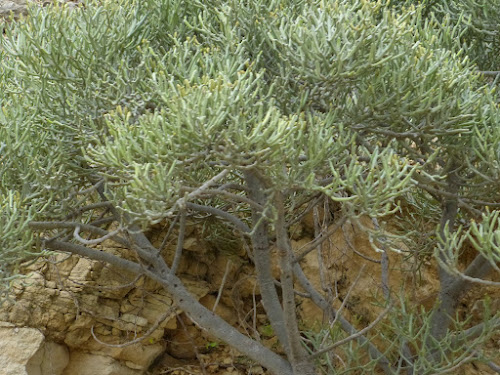
Would we miss out on our beach experience?  Well no, not quite. We made a jaunt south to Sarodrano, crossing the Tropic of Capricorn on the way. We drove past mangrove trees and strange euphorbia with poisonous sap (second photo below).


We passed baby baobab trees.  


Best of all, we were able to see spiny compass trees. Their fleshy cactus-like branches bend with the prevailing wind, giving a directional clue to passing travelers.


Dug out canoes rested on the beach and a few fishermen's huts clung to the sand behind a twig fence. Surely these structures would be scant protection against a cyclone's winds. 


For us, it was time to head inland.  Past the giant baobab trees of the southwest.  


It did take us two tiring days, but our mode of travel was extremely comfortable compared to so many of the vehicles we passed on the road.  I photographed this bus at the gas station where we filled up.  Just a couple kilometers down the road, it was stopped and an ominous pool of oil had appear under it.


Overloaded taxi buses like the one below were a common site on all the roads.


We pulled into Tana as a spectacular moody sunset reached over the rice fields on the city's outskirts.  It kind of felt like arriving home.


06 February 2012

The smoke that thunders


Victoria Falls is one of the world's most outstanding waterfalls. Situated on the Zambezi River, it does indeed thunder at this time of year when the water level is high.  We hiked the 2.5 km trail on the Zimbabwean side of the river to take in the full beauty of this mighty cataract.  I've read that Victoria Falls is 1.7 kilometres wide and 108 meters high.  It is certainly impressive.  

Some people say Victoria Falls was discovered by the explorer missionary, David Livingstone, but the falls were there long before Livingstone made his way through the steaming jungle and first viewed the falls. He did name it, though - after Queen Victoria. Of course we had to acknowledge his efforts by viewing the large brass statue in his honor that stands close to the falls.


Before Livingstone's visit, the falls was known as Mosi-oa-Tunya, "the smoke that thunders" by the ruling Kololo people on the north bank of the Zambezi.  The Nambyan people, living on the south bank, called the falls Chinotimba, meaning "the place that thunders".  

Victoria Falls is grouped with Canada's Niagara, Brazil's Iguazu, and USA's Yosemite as the world's most impressive waterfalls.  Now I can say I have seen three of the four.  Someday, perhaps, we will get to Yosemite.  It was a pretty hike, but I confess, it was probably the wettest hike we've ever taken. 

We reached the swirling cauldron where all the water that has fallen into the long narrow canyon literally turns a corner and continues on downstream. 

And we got a close view of the famous bridge across the river where some insane people bungee jump. More about the bridge in our next post ...

No trip to Victoria Falls is complete without a sunset cruise on the Zambezi River above the falls.  We joined a whole bunch of tourists on a boat for what was really a "booze cruise" (read open bar). It was kind of crazy, but fun, too.  And the sunset was beautiful.