Showing posts with label modes of travel. Show all posts

26 March 2012

Heights and sights of Hong Kong

The view from the Intercontinental Hotel in Kowloon, Hong Kong doesn't disappoint, even in a smog-laden dusk. We stopped in for drinks, but realized we were in time for afternoon tea which was served in high style -- a diminutive three-tier sandwich tray arrived with individual china teapots, cups and strainers for pouring clear tea. Fine, indeed. We sat and watched the junks, ferries and barges plying the harbor waters, still amazed to find ourselves in this fabled, high-speed city.


Built on a 427-square-mile piece of real estate, Hong Kong is home to seven million people. It's a city with a vertical presence; high-rise buildings reach skyward at every turn.


Hong Kong is an interesting city to explore, albeit at a hectic pace. All those residents have places to go too, as we discovered when we found ourselves on the Metro at rush hour. Come with us as we jump aboard at Tin Hau, the station near our hotel. Built deep unserground, the Metro runs just about everywhere in the city. It's the best way to travel.


Long before the Metro, when Hong Kong was an important piece of the British empire, people relied on the the Peak Tramway to reach the the Mid-Level neighbourhoods and the popular lookout on Victoria Peak. Today, taking the funicular to the Peak is a sight-seeing must. So we did, although on a Saturday it took ages to work through the line and catch a ride. The things we do to grab hold of a piece of history. Below, the tram terminus at Garden Road.


Opened in 1888 after three years of construction, the 1.4 km single-track tram route has a passing loop with tram cars. It covers a height difference of almost 400 metres. The cars are beautifully maintained and it was great fun to climb the route.


The view from the Peak looking back down the tramway.


And here, the view of Hong Kong's world-class skyline and harbour.


Rob patiently watches the advancing sunset. Not sure who his dark-haired companion might be, but she does provide scale. Rob and I found it both amusing and practical to be head-and-shoulders taller than most Hong Kong residents.


The sunset sends the hills into silhouette; beyond, a dusky sea lies between Hong Kong Island and the Outlying Islands.


This post could easily end with the sunset and admittedly, several have, but Hong Kong is a city full of life and there are more images to share. Taken in a quiet street not far from the ferry terminal, the photo below captures the "Chinatown" side of Hong Kong I expected to find.


And then there are the well-dressed pedestrians. These young women are typical of the accessorized fashion style the emerging generation loves -- dayglow pumps and all. Hong Kong is headquarters for brand name shopping. In fact, shopping seems to be the national pastime for this Special Administrative Region of the People's Republic of China.


There's no denying the merchandise is glamorous, if very expensive. While I am known to buy purses when I travel, this is as close as I will ever get to a Prada handbag. If you look closely, you can see the high rise retail stores reflected in the display window glass.


Back in Tin Hau, our hotel neighborhood, we wandered in an open-air space and found a wonderful reminder of colonial days. Looking her regal self is Queen Victoria, who accepted Hong Kong as part of her dominions in 1841.


At that time, according to the travel guide, National Geographic Traveler: Hong Kong, the population of Hong Kong Island was about 3650 souls living in about 20 villages and hamlets. Another 2000 lived on boats in the harbor. In the years following the British arrival and the eventual return of the territory to China, Hong Kong has been a magnet for immigrants from mainland China. Everyone comes seeking a better life.

The National Geographic guide does a good job of explaining the people of Hong Kong. Many mainlanders "faced extreme hardships in China, and Hong Kong was the place where they could better their lives and those of their children. People in Hong Kong have an incredible work ethic. It's not unusual for them to work 10 to 12 hours a day, six days a week. These long hours, teeming streets where you often have to battle just to sta. on the sidewalks, and crowded living conditions -- with families of five or six sometimes sharing a tiny apartment -- have given many Hong Kong people a competitive and strident nature." At times this was our experience. Yet we also encountered many kind people who had patience for visitors like us.


16 March 2012

Riding in an oxcart


In the regional town of Kampong Tralach, we took an oxcart ride. It's a bumpy, but fun way to travel. Again, we were on an excursion with our fellow passengers from the cruise boat. Riding two to a cart in a line of maybe 50 carts, we trundled down a country lane past rice fields and rural homes, laughing all the way.

For generations, country folk in Cambodia have used these light, narrow carts for reach their fields and haul fodder for animals or produce to market. And then it was back on board ship for one last night in our lovely floating hotel.


We have enjoyed our time on the Mekong so much, but ahead lies Siem Reap and the splendor of the Khmer kings. We are looking forward to exploring the ancient temples of Ankgor Wat.


13 March 2012

Riding rickshaws in Tan Chau

Reporting on our modes of travel has been fun. In Tan Chau our group hopped aboard one-person rickshaws for a fast tour of the town. The rickshaws are attached directly to a bicycle and are probably more comfortable if you are a tiny Vietnamese.

Still, it is a great way to see a slice of town life. Shops and rice wine rooms are close to the road. While we were busy looking at the locals, they were busy looking at us! The kids get so excited when they see foreigners, they call out, "Hello, hello, hello."

Many people use carts to do their daily chores. We passed several on our ride.


Here's Rob kind of stretched out on his little metal "chariot".


And here's my rickshaw driver. I can only guess at how many years he's been riding down the streets of Tan Chau.

10 March 2012

Floating on the mystic Mekong River

Posted in Siem Reap, northern Cambodia. This post covers some of our time on the Mekong River when we did not have strong wi-fi access.

The cruise ship, ms Amalotus, has become our floating home which we are sharing quite congenially with about 100 other passengers. Some are from Germany, the US, and Australia, but most are from Canada. This is different as up to now we have been travelling on our own with a private guide. And we have encountered very few Canadians on this journey.

We have not cruised much, so this is new, especially since the Amalotus is a small "boutique-style" cruise boat. I have decided that it is really quite lovely to have a moving hotel room with air-conditioning.

Enough context; this post is supposed to be about the Mekong River, a mighty river that has determined the rhythm of life in Indochina for generations. We have learned that the seasons bring hIgh and low water periods which determine the growing of crops, spawning time for fish, even the periods when the river bottom can be "mined" for building sand. Below is a dredging barge.

We were fascinated by the various boats people use to navigate the river.


Above is a long-tail boat. Think outboard motor on a stick! And they can be very noisy, depending on the age and tuning of the motor.

The Mekong is over 4800 km long and flows through seven countries. Its headwaters are in China, just north of Tibet. We've learned that it is the second most biodiverse river in the world, after the Amazon River in South America. The people rely on the river for all manner of fish and freshwater shellfish. If I was a fish person, I would have taken more pictures in the local markets (we have seen some strange creatures), but here are some crayfish for sale.

Each day we've gone ashore by small tenders to visit the villages and learn more about the local way of life.

This morning we went to an idyllic farming community on Evergreen Island. The scene on this canal-like channel away from the main river was so peaceful.

I am looking across the pale green water at the rural countryside as I write this. We have been aboard for three days and we have sailed about 150 km. The riverside is less busy now than it was closer to Saigon and the large towns we have passed along the way. Houses are built on stilts to accommodate the rising water levels of monsoon season from May to October. This one has a definite lean to it.

This evening we will cross into Cambodia to continue our trip upriver to Phnom Penh and the Tonle Sap River.


03 March 2012

One thousand Buddhas


The Mekong River flows past the beautiful town of Luang Prabang. Long covered boats run up and down the river and we climbed aboard one at the King's Steps for another adventure. We were on our way to Pak Ou Caves, a sacred place of worship for the Lao people in this region.

It was a beautiful morning for a boat ride. We were mesmerized by the the passing scene: rounded bamboo-covered hills folding down to long sandbars and nubby limestone rocks where seaweed gathers and fishermen worked I the shallow. February is the tail-end of winter in northern Loas and the river was low. When the new year rains come, the river will rise dramatically. It took an hour and a half to reach the caves which are located in a sheer limestone cliff, accessible only by boat.

It is said the caves were ''discovered'' by King Setthathirat in the 16th century during the time the temple was being built in the village of Pak Ou. The caves have continued as a place of worship for 300 years and it is still possible to see very old wooden Buddha among the hundreds that pilgrims have placed in the caves.

There are two caves. The lower cave, called Tham Thing, is a steep climb up the stone steps from the landing place on the river. Here we were able to see dozens of Buddha statues left by pilgrims. Many are covered in dust and neglected. The majority date from between the 18th and 19th centuries. The oldest are made of wood and many are also made of lacquer and gilded. They can be seen on every shelf and crevice within the cave.


The higher cave, called Tham Phum, is 60 meters above the water level of the Mekong River. it is a stiff climb in the Lao heat, but well worth it. The cave lies in darkness and you must rent a flashlight to be able to see the interior which has many of the features of a temple -- a raised brick floor on which to worship before the altar and many images of Buddha, resting in their serene poses in the dark.

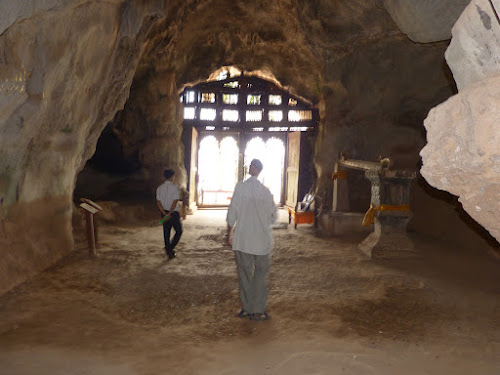
Here Rob and our guide, Thongchanh, are silhouetted against the cave opening.


Many of the statues have been retrieved from temples destroyed in skirmishes with the Chinese and other factions during Laos' sometimes turbulent history. When a Buddha becomes worn and too old to be kept in a temple, it is often brought to the caves as a final sacred resting place.

Like other places in and around Luang Prabang, the Pak Ou Caves are a World Heritage site. This status could cause concern for the lack of conservation of the Buddhas. To my mind, there was a certain grace in seeing their slow disintegration. They were wearing away as all things do in the endless wheel of life, just as the Buddha's teaching tells us.


21 February 2012

Sometimes weather happens

A cyclone was blowing out in the Mozambique channel, off the eastern coast of Madagasgar and we had to make a decision.  From the town of Tulear we were to take a boat south to a little beach village called Anakao for a two-night stay. Getting there might be possible, assuming the port authority gave the local fleet the all clear, but if the stormy weather continued, we might get stuck in Anakao. That could make it very difficult to get back to Tana for our onward flight to Bangkok, Thailand.

We opted to return to Tana by road with Dorique and our driver, Joey, doing in two days what we had earlier done in four. Continuing our Malagasy road trip sounded like more fun than waiting two days in blowy, humid Tulear to catch the regional flight originally booked for us.

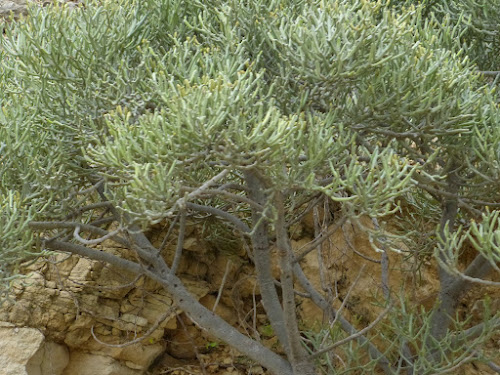
Would we miss out on our beach experience?  Well no, not quite. We made a jaunt south to Sarodrano, crossing the Tropic of Capricorn on the way. We drove past mangrove trees and strange euphorbia with poisonous sap (second photo below).


We passed baby baobab trees.  


Best of all, we were able to see spiny compass trees. Their fleshy cactus-like branches bend with the prevailing wind, giving a directional clue to passing travelers.


Dug out canoes rested on the beach and a few fishermen's huts clung to the sand behind a twig fence. Surely these structures would be scant protection against a cyclone's winds. 


For us, it was time to head inland.  Past the giant baobab trees of the southwest.  


It did take us two tiring days, but our mode of travel was extremely comfortable compared to so many of the vehicles we passed on the road.  I photographed this bus at the gas station where we filled up.  Just a couple kilometers down the road, it was stopped and an ominous pool of oil had appear under it.


Overloaded taxi buses like the one below were a common site on all the roads.


We pulled into Tana as a spectacular moody sunset reached over the rice fields on the city's outskirts.  It kind of felt like arriving home.