
The Mekong River flows past the beautiful town of Luang Prabang. Long covered boats run up and down the river and we climbed aboard one at the King's Steps for another adventure. We were on our way to Pak Ou Caves, a sacred place of worship for the Lao people in this region.

It was a beautiful morning for a boat ride. We were mesmerized by the the passing scene: rounded bamboo-covered hills folding down to long sandbars and nubby limestone rocks where seaweed gathers and fishermen worked I the shallow. February is the tail-end of winter in northern Loas and the river was low. When the new year rains come, the river will rise dramatically. It took an hour and a half to reach the caves which are located in a sheer limestone cliff, accessible only by boat.
It is said the caves were ''discovered'' by King Setthathirat in the 16th century during the time the temple was being built in the village of Pak Ou. The caves have continued as a place of worship for 300 years and it is still possible to see very old wooden Buddha among the hundreds that pilgrims have placed in the caves.
There are two caves. The lower cave, called Tham Thing, is a steep climb up the stone steps from the landing place on the river. Here we were able to see dozens of Buddha statues left by pilgrims. Many are covered in dust and neglected. The majority date from between the 18th and 19th centuries. The oldest are made of wood and many are also made of lacquer and gilded. They can be seen on every shelf and crevice within the cave.

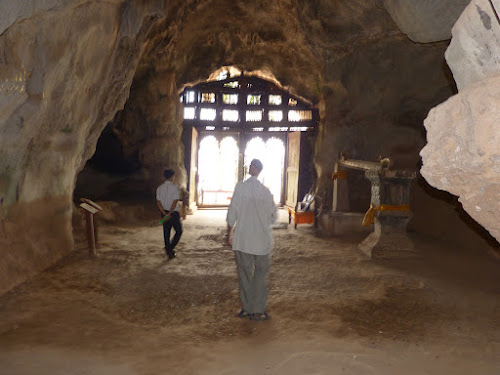
The higher cave, called Tham Phum, is 60 meters above the water level of the Mekong River. it is a stiff climb in the Lao heat, but well worth it. The cave lies in darkness and you must rent a flashlight to be able to see the interior which has many of the features of a temple -- a raised brick floor on which to worship before the altar and many images of Buddha, resting in their serene poses in the dark.

Here Rob and our guide, Thongchanh, are silhouetted against the cave opening.
Many of the statues have been retrieved from temples destroyed in skirmishes with the Chinese and other factions during Laos' sometimes turbulent history. When a Buddha becomes worn and too old to be kept in a temple, it is often brought to the caves as a final sacred resting place.
Like other places in and around Luang Prabang, the Pak Ou Caves are a World Heritage site. This status could cause concern for the lack of conservation of the Buddhas. To my mind, there was a certain grace in seeing their slow disintegration. They were wearing away as all things do in the endless wheel of life, just as the Buddha's teaching tells us.


