Showing posts with label culture. Show all posts

21 March 2012

When the apsaras dance

Dressed in the silk and gold of a traditional Khymer costume, a dancer turns and bends in a closing gesture. She presses a lotus flower to her lips, covering a softly enigmatic smile. The nighttime dance ends, the music fades ...


Created to entertain the Khmer royalty, classical Cambodian dance -- also called Apsara dance -- presents themes and stories inspired primarily by the Reamker (the Cambodian version of the Indian classic, the Ramayana) and the age of Angkor. The dancers in the performance we saw at our hotel had an ethereal quality that reminded us that in Hindu myth, the apsaras -- or celestial dancers -- were one of the 13 gifts born of the Churning of the Sea of Milk, a 1,000-year effort in which the gods and demons cooperated under Vishnu's guidance to obtain the elixir of immortality.

In Hindu myth, the apsaras are paired with the ghandarvas, the court musicians of Indra, king of the demi-gods. The ghandarvas make music to which their beautiful consorts dance in the celestial palaces.

 
Hundreds of carved apsaras decorate the Angkor temples, over 1800 in Angkor Wat itself. To my mind, they give the temple buildings a joyous air. It is said that no two are exactly alike in their dress and hairstyle. Serene, mysterious, the apsaras of Angkor are a captivating expression of femininity and exquisite works of art. View more apsaras and more information about their significance.

The ancient art form of Khmer dance has always received royal patronage; even into the 20th century this has been true.  Queen Sisowath Kossamak "fostered a resurgence in the study and development of Khmer traditional dance, but also helped move it out of the palace and popularize it," according to one Cambodian travel guide.  The Queen trained her granddaughter Princess Bopha Devi from early childhood in the art of traditional dance.  In the 1950s and 60s, the princess was the face of Khmer traditional dance, both in Cambodia and around the world. Many traditional dances that are seen in performances today were developed and refined between the 1940s and 1960s under the guidance and patronage of Queen Sisowath Kossamak at the Conservatory of Performing Arts and the Royal University of Fine Arts in Phnom Penh. 
 
This video of the Royal Ballet of Cambodia gives a wonderful glimpse into the music, the costuming and most of all the highly stylized gestures of this rich dance form.  Imagine the apsaras have stepped off the temple frieze to perform for a moment in time.


16 March 2012

Riding in an oxcart


In the regional town of Kampong Tralach, we took an oxcart ride. It's a bumpy, but fun way to travel. Again, we were on an excursion with our fellow passengers from the cruise boat. Riding two to a cart in a line of maybe 50 carts, we trundled down a country lane past rice fields and rural homes, laughing all the way.

For generations, country folk in Cambodia have used these light, narrow carts for reach their fields and haul fodder for animals or produce to market. And then it was back on board ship for one last night in our lovely floating hotel.


We have enjoyed our time on the Mekong so much, but ahead lies Siem Reap and the splendor of the Khmer kings. We are looking forward to exploring the ancient temples of Ankgor Wat.


03 March 2012

One thousand Buddhas


The Mekong River flows past the beautiful town of Luang Prabang. Long covered boats run up and down the river and we climbed aboard one at the King's Steps for another adventure. We were on our way to Pak Ou Caves, a sacred place of worship for the Lao people in this region.

It was a beautiful morning for a boat ride. We were mesmerized by the the passing scene: rounded bamboo-covered hills folding down to long sandbars and nubby limestone rocks where seaweed gathers and fishermen worked I the shallow. February is the tail-end of winter in northern Loas and the river was low. When the new year rains come, the river will rise dramatically. It took an hour and a half to reach the caves which are located in a sheer limestone cliff, accessible only by boat.

It is said the caves were ''discovered'' by King Setthathirat in the 16th century during the time the temple was being built in the village of Pak Ou. The caves have continued as a place of worship for 300 years and it is still possible to see very old wooden Buddha among the hundreds that pilgrims have placed in the caves.

There are two caves. The lower cave, called Tham Thing, is a steep climb up the stone steps from the landing place on the river. Here we were able to see dozens of Buddha statues left by pilgrims. Many are covered in dust and neglected. The majority date from between the 18th and 19th centuries. The oldest are made of wood and many are also made of lacquer and gilded. They can be seen on every shelf and crevice within the cave.


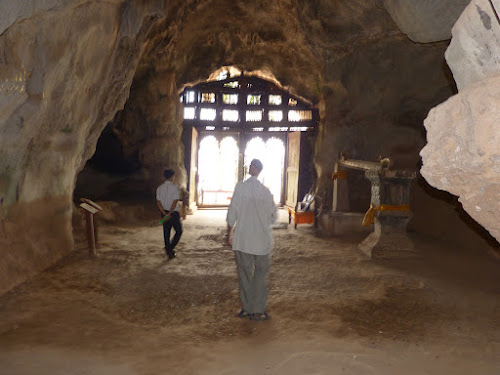
The higher cave, called Tham Phum, is 60 meters above the water level of the Mekong River. it is a stiff climb in the Lao heat, but well worth it. The cave lies in darkness and you must rent a flashlight to be able to see the interior which has many of the features of a temple -- a raised brick floor on which to worship before the altar and many images of Buddha, resting in their serene poses in the dark.

Here Rob and our guide, Thongchanh, are silhouetted against the cave opening.


Many of the statues have been retrieved from temples destroyed in skirmishes with the Chinese and other factions during Laos' sometimes turbulent history. When a Buddha becomes worn and too old to be kept in a temple, it is often brought to the caves as a final sacred resting place.

Like other places in and around Luang Prabang, the Pak Ou Caves are a World Heritage site. This status could cause concern for the lack of conservation of the Buddhas. To my mind, there was a certain grace in seeing their slow disintegration. They were wearing away as all things do in the endless wheel of life, just as the Buddha's teaching tells us.


29 February 2012

Making merit in Luang Prabang

Our travels brought us to the lively yet serene town of Luang Prabang in north central Loas. The town of 45,000 was named a UNESCO World Heritage site in 1995 to protect its rich, but fragile monastic culture and traditional architecture.

In her carefully researched book, Ancient Luang Prabang, Denise Heywood observes that, "populated by monks -- although increasingly by tourists -- the town resonates with a spiritual aura. Yet, in spite of the growth of tourism, it still has an atmosphere of seclusion, a place apart from the the modern world."

The experience that best captured this spiritual quality for us was the early morning offering of alms to the monks. This offering is a way of earning merit. The Lao people believe that making merit regularly will bring them happiness, peace and other good things. It is through the gaining of merit that a person strengthens their ability to overcome life's obstacles, and ultimately, reach nirvana or divine peace beyond this world.

The giving of alms is one common way to gain merit. At 6 am we gathered on the main street with other local people and tourists to offer alms to the monks. In Luang Prabang there are about 300 monks living and studying in the many temples and they depend on alms for their two daily meals.

Silently we placed sweet sticky rice in their alms bowls as they passed. The rice sticks to itself and easily forms into a ball, but it doesn't stick to your fingers. It is very rich and sweet-tasting. The sticky rice was prepared for us and stays surprisingly warm in the small round rice box, if you keep it covered.


It is customary for men to stand to offer the alms. It is acceptable to glamce at the monks, but but out of respect you are not supposed to make eye contact. I stepped away from our place to take photos. Only the novices, would accept alms from me, a woman tourist. All seemed happy to accept alms from Rob, that very tall tourist!

The monks cover themselves fully with their saffron-colored robes, while the novices are bare-armed. The youngest novice brings up the rear of the line. The giving of alms is repeated every day.


28 February 2012

Temples of Chiang Mai

The city of Chiang Mai, 700 km north of Bangkok, is a very old city with a rich cultural heritage. Nestled in the Ping River valley below some of the tallest mountinas in Thailand, the city was founded by King Mangrai as his "new capital" - Chiang Mai - in 1296.

With our guide, Mr. Chai (below), we were able to see and do a lot in our three days in the city. Chiang Mai has many temples and centers for monastic learning, as evidenced by the number of monks we saw walking about the city. Our touring was enriched with visits to some of the important temples and Chai's patient explanation of the basic tenets of Buddhism as practiced in this region of Thailand.

According to legend, "King Ku Na invited the venerable Sumana Thera, a very pious monk from Sukhothai to bring the Buddhism of Sri Lanka to Chiang Mai. The King offered him the royal flower garden (Suan Dok) as a place to build a temple. The temple was established in 1371. Wat Suan Temple is famous for its golden chedi which houses a relic of the Buddha.

The temple itself is very large and is used for royal ceremonies as well as everyday worship. The monk in this picture receives gifts from two young women. Chai suggested that they may be sisters who came on the date of a family occasion in remembrance of parents who have passed away. It is an opportunity to remember and receive a blessing. The gifts offered are practical things like detergent, shaving cream and razors. The monk receives them, but they are shared within the monastic community.

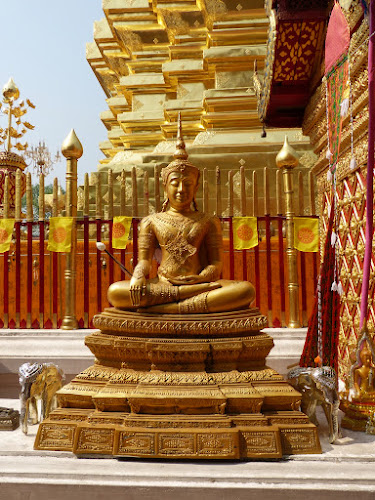
We travelled the mountain highway above the city to visit Wat Phrathat Doi Suthep. The steps led us to a golden temple complex filled with Sunday visitors. Legend has it that the relic of the Buddha that was honoured at the Flower Garden temple was divided in two and gifted by one king to another as a gesture of peace and brotherhood. The second relic was placed on the back of a white elephant. The elephant was let to roam and climb the mountain freely. The elephant died and where his body lay, the king ordered that a temple be built. In Thailand, there are apparently special ways to divine the sacred.


Doi Suthep has become an important relgious site for Thai people. Many people were saying prayers as they circled the chedi that is said to house the relics of Buddha.


The holy site clearly belonged to the people. These monks were among the visitors and they were taking pictures of the same things we were.


This monk offered blessings to anyone who came to him.


The last temple we visited, Wat Chedi Luang, was our favorite. King Saen Muang Ma began building the chedi, according to the Chiang Mai online guide, "to enshrine the relics of his father at the end of the 14th century, but King Tilokarat completed it. The chedi used to be 90 meters high before it was partly destroyed in an earthquake in 1545; it was to remain the tallest structure in Chiang Mai for over 500 years. The present restored chedi is about 60 meters high." The second picture below shows a detail of the elephant statuary that would have surrounded the upper level of the chedi.


I liked the reclining Buddha resting in a beautifully painted temple off to the side.


As we listened to Mr. Chai's explanation of the life and teachings of Buddha, we agreed that there is wisdom to be found in the precepts of Buddhism. While there are many more temples in this ancient city, we had some other places to visit in our last days in Thailand. We did take time to photograph the restored moat that surrounds the old city and the ancient city walls that stand vigil today even as the tuk-tuks (motorcycle taxis) and cars of a busy modern city hurry by.


23 February 2012

The Grand Palace

They say that no visit to Bangkpk is complete without seeing the Grand Palace, the golden palace complex of the Thai kings. We took a half-day tour with some other tourists and the palace was worth seeing.


Established in 1782 by King Rama I when he ascended the throne, the palace complex includes government offices and the renowned Temple of the Emerald,Buddha as well as the royal residence of earlier kings. The current Thai monarch, King Bhumibol Adulyadej or Rama IX, came to the throne in 1946 and is the longest-serving head of state in the world.

The palace complex is a madhouse to visit with tourists, school groups and temple worshippers all milling around the various buildings. You have to get into the chaos of it all and not worry about capturing pristine photos. Besides, the really famous artifact -- the Emerald Buddha -- is not something you can photograph from inside the temple.

The beautiful building that houses the Buddha -- the Royal Monastery -- is one of the most venerated sites in Thailand where people come to pay their respects to Lord Buddha and his teachings. We saw people trying to pray amid the tourists and the security guards inside the noisy temple. The Emerald Buddha is, in fact, carved from a piece of green jade. It was held in Laos for 226 years before being repatriated to Thailand by the Thai army of Rama I in 1778. When the king established Bangkok as the capital, the Buddha was placed in the monastery.

Exterior of the Royal Monastery

One building that appealed to me was the reliquary in the shape of a golden chedi or stupa. The tiles on the structure are real gold. It is too big to photograph completely, so I offer part of the building at an artsy angle.

The Chakri Maha Prasat was built by Rama V in 1882. It represents a unique blend of Victorian and Thai architectural styles. It you study the building, you can see that the lower portion has the look of Buckingham Palace in London, complete with a reviewing balcony. Look up and you can see that the roof structure is Thai in design. The bonsai trees are old, much older actually than the building behind them.


I was taken with the fascinating details in the buildings and the statuary.


By the end of our tour of the palace, we felt we'd had a short introduction to Thai royal splendor. We are ready for more palaces, temples and treasures as we travel north to the Thai city of Chiang Mai and then on to Laos.


15 February 2012

A Malagasy road trip

We have been in Madagascar for over a week. After spending a short time in the capital in Antananarivo - Tana as the locals call it - we have been making our way south-southeast by car.  Along the way we've  had a few adventures which I am planning to share in separate posts.  First, meet Dorique, our intrepid guide.  He met us at the airport, sign in hand, and he's been patiently helping us learn a little Malagasy and practice our rather sad French. He has a lot of chutzpah which is what you want in a guide.


Our plan is to traverse the country from Manakara on the east coast to Tulear on the west. Since we are moving fast, let me share some rough cuts from the road -- pictures snapped from the car and probably in need of editing -- and our impressions of the Malagasy people.

Madagascar feels to us like the perfect cultural transition between our fairly intense experience of Africa and our upcoming travels in Southeast Asia. This island was populated long ago by Malaysian sailors and traders.  There is evidence of these roots in the faces and the stature of the people we see on the street.  Our strongest impression is of a happy, confident and capable population. Make that a young population; there seem to be infants and toddlers everywhere.  From what we are learning, population growth is a central issue for this nation where the environment is fragile and the Catholic church has great influence.

Most Malagasy still live in the countryside and we've been able to glimpse that rural life.  


From what we have seen, for many rural Malagasy life is lived largely on the road, quite literally.  The national highway system is really the only maintained road, so there are advantages to living on its shoulder. People here often walk many kilometers at a time, to market, to work In the fields, to fetch water, to find wood.  A good road makes for easier walking and cart pushing.  We've noticed that homes and market stalls are built very close to the road.  Some even use the shoulder as a place to dry rice and beans.    


The road is key for driving zebu, the predominant domestic animal, to market.  A bovine like our beef cattle, it comes with a shoulder hump, especially large and impressive on the bulls. We have found it on the menu in all the restaurants and it is good.

There are many Malagasy who live in small villages far from any road. Their births are never registered and they live their lives without ever being counted in a census or registered for an election. The real population of Madagascar can only be estimated.

In this country, everything is done by hand.  Even the painting of lines on the road!  The people - and that's both men and women - carry all manner of things on their head, but for heavy loads, they use small push carts, most often with wooden wheels.  We can only imagine what treasure a set of small inflated tires like we could purchase any Saturday at Canadian Tire would be for these hard working people.  

We are here in the "off season" when there are few tourists from France, Italy and Germany.  As we drive, we were captivated by the wide smiles and waves we received as passing visitors. People from away are still a novelty.