Showing posts with label religious beliefs. Show all posts

20 March 2012

A monk walks in the temple

There is something very right and special about seeing Buddhist monks walking in the Angkor temples. They are tourists, too -- often from Thailand -- come to experience these ancient sacred spaces. I frequently tried to photograph them.


Mr. Thy, our guide, told us that the monks are quite comfortable with being photographed. As this monk walked away, I was wishing I had got a better shot. So I asked Mr. Thy if he could request a photo for me. The monk agreed and I took my picture.


Then Mr. Thy told me to stand with the monk for another photo, telling me to take care not to touch the monk's robes. We stood for my picture, then the monk handed Mr. Thy his camera for his own souvenir shot with me.  Many young men enter a monastery for a period of time, perhaps two or three years, to study the Buddha teachings. To me it seemed like a way of deciding what they wanted to do in life. Some stay and become monks, but many return to lay life, get married and pursue a livelihood. In a country where education is expensive and good paying employment is not easy to find, the monastic life attracts many.


 Below, young monks work on a well at the monastic teaching centre of Vipassana Dhura we visited before coming to Siem Reap to see Angkor. I loved their engaged faces as they worked together in the late afternoon sun. Their robes are almost the same color as the iron-rich earth.


Again, at Angkor Wat, a monk walks on the stones by the reflecting pool. On the road to wisdom, a traveller may consider the words of the Buddha: "It is better to travel well than to arrive."

19 March 2012

Sundown at Angkor Wat

For many people traveling to Cambodia, seeing the famous temple complex of Angkor Wat is the centerpiece of their trip. Built in the reign of Suryavarman II in the first half of the 12th century both as the capital and the state temple, it is the world's largest religious monument and the grandest of all the Khymer temples. The scale of the site, which covers 82 hectares, is immense and so hard to capture in photographs. Below, we are standing in front of the reflecting pool which fills during monsoon season. The main temple is behind us.


The temple itself stands in the middle on a terrace that covers nearly nine hectares. It is amazing to think that this architectural marvel was completed during the reign of one king. The pyramidal towers, created by means of stepped terraces, are a major feature of Khymer architecture and are meant to symbolize Mount Meru, the centre of the Hindu universe. At Angkor Wat, the summit of the temple is crowned with five towers.


It is possible to climb to the summit, but we were discouraged by the line-up just to begin the climb! We opted to walk with our guide, Mr Thy, and appreciate more of the structures and sculptures.


As the light changed with the setting sun, we saw the warm red tones of the sandstone deepen. And the sculptured lions darken.


The sun pushed the library into sharp relief.


And then it was time to walk the wide stone causeway across the broad moat that surrounds Angkor Wat. We left through the king's gate which is always larger than the other entry gates. See, there's my king below, appreciating our day's exploration of a true wonder.


18 March 2012

Splendor of the Khmer kings

With the city of Siem Reap as our new base, we were once again touring on our own. We met our guide, Mr. Thy (pronounced "tEE"), who would quickly win our hearts with his passion for the archaeological sites of Angkor, the UNESCO heritage site that brought us and so many others to this region of Cambodia.


Stretching over some 400 square kilometers, and including forested area and manmade lakes, Angkor Archaeological Park contains the magnificent remains of the capitals of the Khmer Empire from the 9th to the 15th century. They include the famous Temple of Angkor Wat and, at Angkor Thom, the Bayon Temple with its enigmatic stone faces. In the late morning light, these beautiful sculptures were challenging to photograph.


It would be easy to write a dozen posts about all that we saw in our three days of temple exploration. We'll share a little about the Bayon Temple because it is both famous and beautiful. Your really cannot see the sculpted detail of the temple from a distance; at first site it looks like a pile of rock, albeit a pile of rock guarded by both gods (below left) and demons (yes, below right).


The Kyhmer king, Jayavarman VII, began construction of Bayon Temple in the 12th century. Building was continued by his successors as they too looked to leave their mark on the kingdom. Banyon Temple is a state temple, built by the king to serve the royal city of Angkor Thom. As my guide book, Ancient Angkor by Freeman and Jacques explains, it uses a mass of face-towers to create a stone mountain of ascending peaks. Today there are 37 towers standing, although there is debate about how many towers were constructed.

The complexity of Banyon Temple speaks to the passing of relgious phases in the Khmer kingdom. Again, according to my guide book, the temple was initially built to honour the pantheon of Hindu gods, then shifted to Buddhism. We learned that the religious focus of this and other Angkor temples changed over time, almost like waves washing over a sand beach, as warring groups achieved victory and imposed their beliefs on the temples. Even today, the temple holds Buddha statues which are considered sacred. Often these statues were attended by people who served in a lay capacity as monks and nuns.

This sweet elderly lady (a lay nun) offered me an additional blessing, wishing that the blessings of Buddha would stay with me. I believe they will.


16 March 2012

A blessing at Vipassana Dhura

Thirty-five kilometers from Phonm Penh is another world. Oudong was an ancient Khymer stronghold until King Norodom re-established the capital at Phnom Penh in 1865. Located on the hilly ridge of Preah Reach Throap, Oudong once boasted dozens of temples and royal stupas. Most were destroyed in air strikes against Khmer Rouge installations ordered by Lon Nol, a general who took power in Cambodia through a 1979 coup. (Believe me when I say that the history of Cambodia is complicated.) A few monasteries have survived along with some the royal funerary stupas. The domed and spired towers below are stupas.


We visited Vipassana Dhura, the biggest Buddhist monastery in Cambodia. The temple (directly above) is new and serves as a Buddhist study center. We entered the temple and were immediately impressed with the size of the building. A huge Buddha dominates the space.


We joined a large group of tourists who had come for a blessing from two monks. We sat before them on mats. The chanting, which is the main part of the blessing ceremony, began. We bowed our heads and allowed the chanting to center us. Even in that large group, in the humidity and heat, it was possible to still my thoughts.


Again and again, the monks tossed fresh jasmine blossoms over the crowd. They gently rained down on us, falling in our clothes and the mat around with a soft pattering. I gathered a handful to hold the blessing a little longer.


03 March 2012

One thousand Buddhas


The Mekong River flows past the beautiful town of Luang Prabang. Long covered boats run up and down the river and we climbed aboard one at the King's Steps for another adventure. We were on our way to Pak Ou Caves, a sacred place of worship for the Lao people in this region.

It was a beautiful morning for a boat ride. We were mesmerized by the the passing scene: rounded bamboo-covered hills folding down to long sandbars and nubby limestone rocks where seaweed gathers and fishermen worked I the shallow. February is the tail-end of winter in northern Loas and the river was low. When the new year rains come, the river will rise dramatically. It took an hour and a half to reach the caves which are located in a sheer limestone cliff, accessible only by boat.

It is said the caves were ''discovered'' by King Setthathirat in the 16th century during the time the temple was being built in the village of Pak Ou. The caves have continued as a place of worship for 300 years and it is still possible to see very old wooden Buddha among the hundreds that pilgrims have placed in the caves.

There are two caves. The lower cave, called Tham Thing, is a steep climb up the stone steps from the landing place on the river. Here we were able to see dozens of Buddha statues left by pilgrims. Many are covered in dust and neglected. The majority date from between the 18th and 19th centuries. The oldest are made of wood and many are also made of lacquer and gilded. They can be seen on every shelf and crevice within the cave.


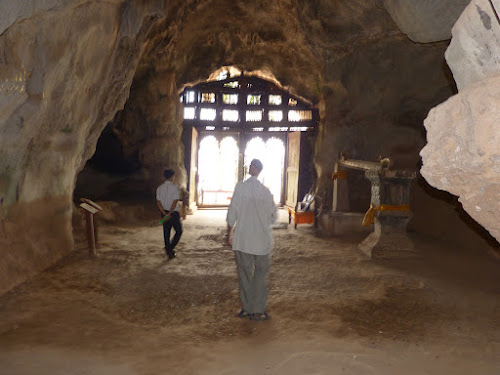
The higher cave, called Tham Phum, is 60 meters above the water level of the Mekong River. it is a stiff climb in the Lao heat, but well worth it. The cave lies in darkness and you must rent a flashlight to be able to see the interior which has many of the features of a temple -- a raised brick floor on which to worship before the altar and many images of Buddha, resting in their serene poses in the dark.

Here Rob and our guide, Thongchanh, are silhouetted against the cave opening.


Many of the statues have been retrieved from temples destroyed in skirmishes with the Chinese and other factions during Laos' sometimes turbulent history. When a Buddha becomes worn and too old to be kept in a temple, it is often brought to the caves as a final sacred resting place.

Like other places in and around Luang Prabang, the Pak Ou Caves are a World Heritage site. This status could cause concern for the lack of conservation of the Buddhas. To my mind, there was a certain grace in seeing their slow disintegration. They were wearing away as all things do in the endless wheel of life, just as the Buddha's teaching tells us.


29 February 2012

Making merit in Luang Prabang

Our travels brought us to the lively yet serene town of Luang Prabang in north central Loas. The town of 45,000 was named a UNESCO World Heritage site in 1995 to protect its rich, but fragile monastic culture and traditional architecture.

In her carefully researched book, Ancient Luang Prabang, Denise Heywood observes that, "populated by monks -- although increasingly by tourists -- the town resonates with a spiritual aura. Yet, in spite of the growth of tourism, it still has an atmosphere of seclusion, a place apart from the the modern world."

The experience that best captured this spiritual quality for us was the early morning offering of alms to the monks. This offering is a way of earning merit. The Lao people believe that making merit regularly will bring them happiness, peace and other good things. It is through the gaining of merit that a person strengthens their ability to overcome life's obstacles, and ultimately, reach nirvana or divine peace beyond this world.

The giving of alms is one common way to gain merit. At 6 am we gathered on the main street with other local people and tourists to offer alms to the monks. In Luang Prabang there are about 300 monks living and studying in the many temples and they depend on alms for their two daily meals.

Silently we placed sweet sticky rice in their alms bowls as they passed. The rice sticks to itself and easily forms into a ball, but it doesn't stick to your fingers. It is very rich and sweet-tasting. The sticky rice was prepared for us and stays surprisingly warm in the small round rice box, if you keep it covered.


It is customary for men to stand to offer the alms. It is acceptable to glamce at the monks, but but out of respect you are not supposed to make eye contact. I stepped away from our place to take photos. Only the novices, would accept alms from me, a woman tourist. All seemed happy to accept alms from Rob, that very tall tourist!

The monks cover themselves fully with their saffron-colored robes, while the novices are bare-armed. The youngest novice brings up the rear of the line. The giving of alms is repeated every day.


28 February 2012

Temples of Chiang Mai

The city of Chiang Mai, 700 km north of Bangkok, is a very old city with a rich cultural heritage. Nestled in the Ping River valley below some of the tallest mountinas in Thailand, the city was founded by King Mangrai as his "new capital" - Chiang Mai - in 1296.

With our guide, Mr. Chai (below), we were able to see and do a lot in our three days in the city. Chiang Mai has many temples and centers for monastic learning, as evidenced by the number of monks we saw walking about the city. Our touring was enriched with visits to some of the important temples and Chai's patient explanation of the basic tenets of Buddhism as practiced in this region of Thailand.

According to legend, "King Ku Na invited the venerable Sumana Thera, a very pious monk from Sukhothai to bring the Buddhism of Sri Lanka to Chiang Mai. The King offered him the royal flower garden (Suan Dok) as a place to build a temple. The temple was established in 1371. Wat Suan Temple is famous for its golden chedi which houses a relic of the Buddha.

The temple itself is very large and is used for royal ceremonies as well as everyday worship. The monk in this picture receives gifts from two young women. Chai suggested that they may be sisters who came on the date of a family occasion in remembrance of parents who have passed away. It is an opportunity to remember and receive a blessing. The gifts offered are practical things like detergent, shaving cream and razors. The monk receives them, but they are shared within the monastic community.

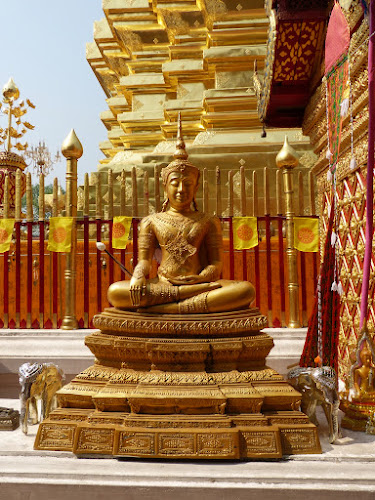
We travelled the mountain highway above the city to visit Wat Phrathat Doi Suthep. The steps led us to a golden temple complex filled with Sunday visitors. Legend has it that the relic of the Buddha that was honoured at the Flower Garden temple was divided in two and gifted by one king to another as a gesture of peace and brotherhood. The second relic was placed on the back of a white elephant. The elephant was let to roam and climb the mountain freely. The elephant died and where his body lay, the king ordered that a temple be built. In Thailand, there are apparently special ways to divine the sacred.


Doi Suthep has become an important relgious site for Thai people. Many people were saying prayers as they circled the chedi that is said to house the relics of Buddha.


The holy site clearly belonged to the people. These monks were among the visitors and they were taking pictures of the same things we were.


This monk offered blessings to anyone who came to him.


The last temple we visited, Wat Chedi Luang, was our favorite. King Saen Muang Ma began building the chedi, according to the Chiang Mai online guide, "to enshrine the relics of his father at the end of the 14th century, but King Tilokarat completed it. The chedi used to be 90 meters high before it was partly destroyed in an earthquake in 1545; it was to remain the tallest structure in Chiang Mai for over 500 years. The present restored chedi is about 60 meters high." The second picture below shows a detail of the elephant statuary that would have surrounded the upper level of the chedi.


I liked the reclining Buddha resting in a beautifully painted temple off to the side.


As we listened to Mr. Chai's explanation of the life and teachings of Buddha, we agreed that there is wisdom to be found in the precepts of Buddhism. While there are many more temples in this ancient city, we had some other places to visit in our last days in Thailand. We did take time to photograph the restored moat that surrounds the old city and the ancient city walls that stand vigil today even as the tuk-tuks (motorcycle taxis) and cars of a busy modern city hurry by.